
Select the 400 hydraulic pig dehairing machine by its loading arrangement, drum drives and discharge interface for scalded carcasses. Allow for its 3370 × 1560 × 2370 mm overall dimensions, loading-rake clearance and hydraulic-station access when coordinating the scalding outlet and downstream receiving equipment.
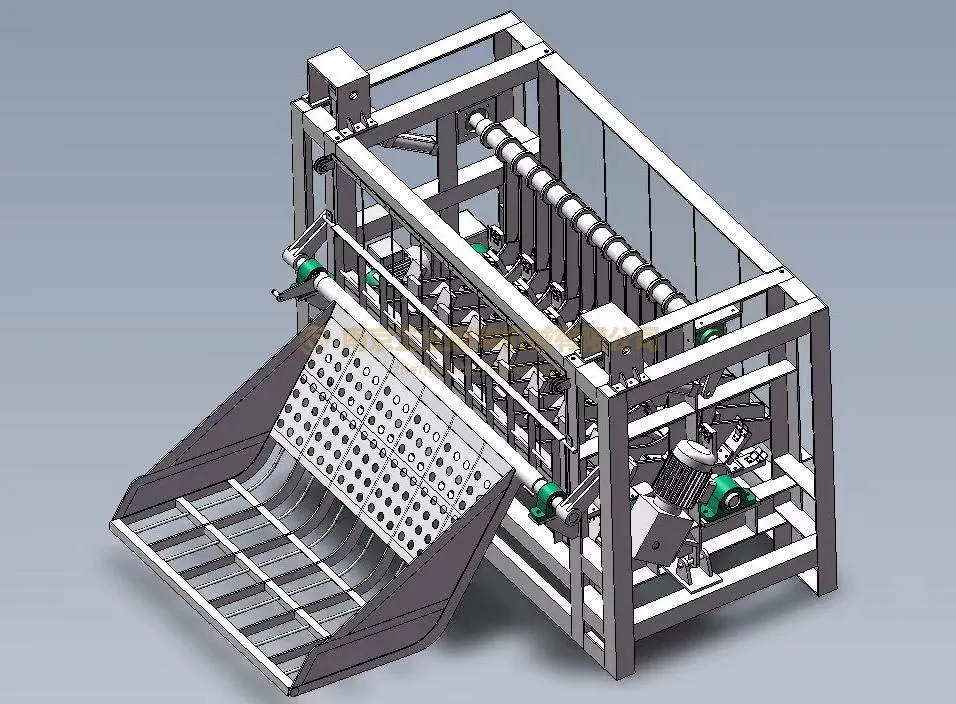
400 hydraulic-dehairer reference specification
| Specification | Documented configuration |
|---|---|
| Overall dimensions | 3370 × 1560 × 2370 mm |
| Large drum motor | 9.2 kW |
| Small drum motor | 5.5 kW |
| Hydraulic-station motor | 7.5 kW |
| Protection listed in the leaflet | IP55 |
| Loading-rake pipe | φ108 × 12 mm seamless steel pipe |
| Main/small drum pipe | φ245 × 12 mm / φ180 × 12 mm |
| Cradle and retaining-plate thickness | 25 mm |
| Frame finish | Hot-dip galvanized |
“400” is the equipment designation used in the leaflet; it is not a stated 400-pigs/hour capacity.
Configuration source: Zhengye 400 hydraulic-dehairer leaflet, page 4.
What the 400 hydraulic dehairer is built from
The 400 is a batch dehairing machine. It works on pig carcasses that have just come out of the scalding tank and removes the bristles before the carcass moves to the next station. The machine is assembled from five component groups: frame, drive motors, hydraulic system, large and small dehairing drums, and the loading rake.
| Component | What it does in the cycle |
|---|---|
| Frame | Hot-dip galvanized structure that carries the drums, the cradle and the loading rake, and sets the 3370 × 1560 × 2370 mm overall envelope. |
| Drive motors | 9.2 kW on the large drum, 5.5 kW on the small drum and 7.5 kW on the hydraulic station; IP55 protection as listed in the leaflet. |
| Hydraulic system | Hydraulic station and cylinders that power the loading-rake movement, so the rake can lift and turn a scalded carcass into the drum zone. |
| Large and small dehairing drums | φ245 × 12 mm and φ180 × 12 mm pipe drums. Their rotation scrapes the bristles off the carcass surface after scalding. |
| Loading rake | φ108 × 12 mm seamless steel pipe rake that lifts the carcass out of the scalding tank and feeds it to the drums. |
The working order is: scalding → the loading rake lifts the carcass into the machine → the large and small drums remove the bristles → the carcass leaves to the receiving chute or the next conveyor.
Dehairing only works on a carcass that has been scalded properly. This machine does not replace the scalding tank, and scalding temperature and dwell time still decide how clean the carcass comes out and whether the skin stays intact.
Component list per the Zhengye 400 structure description; the final configuration is fixed in the contract technical annex.
Match the loading and discharge geometry
Provide the scalding-tank edge, water level, carcass presentation and loading-rake clearance. At the outlet, show the receiving chute, water tank or next conveyor and the maintenance space around both drum drives. The accepted arrangement should show where hair, spray water and washdown leave the work area.
Choose the control sequence with the upstream module
The leaflet describes manual, single-cycle and automatic modes. Specify how the selected mode communicates with scalding discharge and the downstream receiving point, and identify the operator position and safe access for replacing wear parts.
Compare the continuous spiral dehairer and the scalding/dehairing module solution. Bring your upstream drawing to the equipment scope review.
Hydraulic pig dehairing machine price and supply questions
How is the 400 hydraulic dehairing machine priced?
Price depends on drum size, the hydraulic drive set, loading and discharge height and the frame specification. A small-plant single unit sits well below a fully automated line machine.
Can I buy just the hydraulic dehairing machine?
Yes. It is available for sale as a standalone unit for small plants and single-station lines, without the rest of the slaughter line.
What information is needed for a quotation?
Daily throughput, carcass weight, available floor space, power supply and the scalding method used upstream.